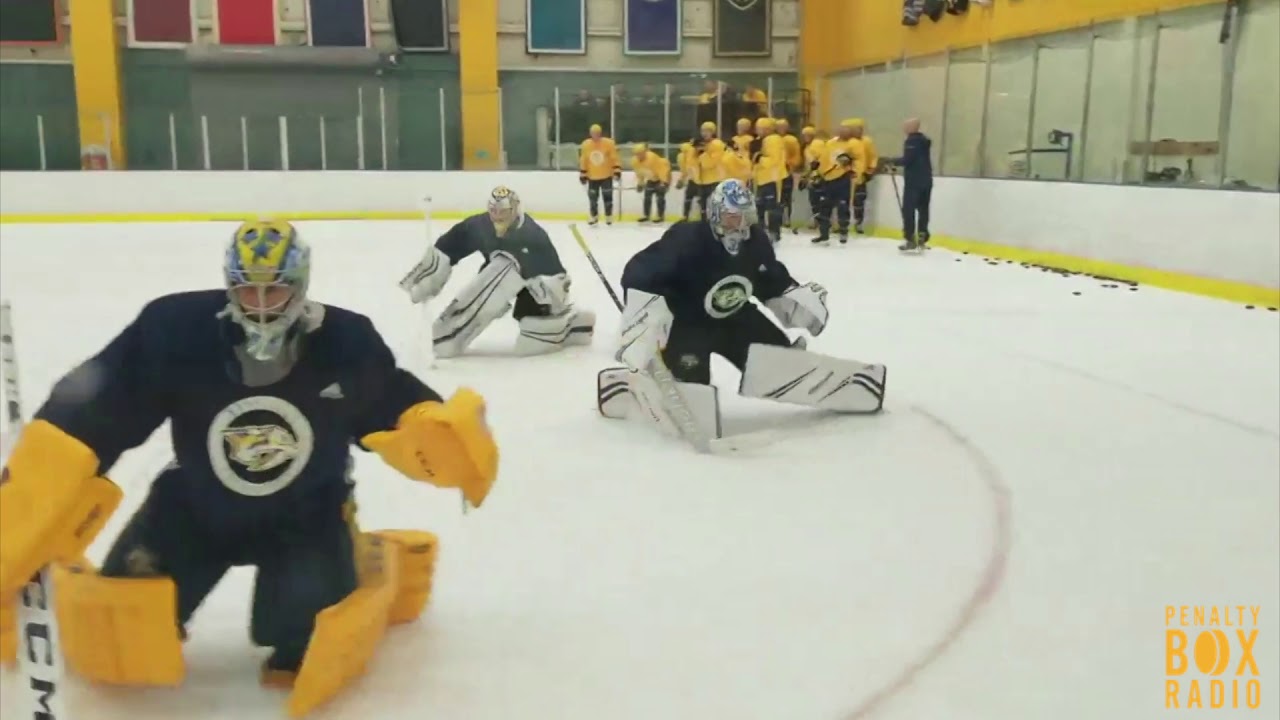
When fans watch an elite ice hockey goaltender slide effortlessly from post to post in the butterfly position, the credit is usually given to their raw athleticism or the slick synthetic materials of their leg pads. We focus on the massive, rectangular blocks of foam because they are the most visible part of the position.
However, the modern butterfly slide—a violent, explosive lateral movement executed while kneeling on the ice—is not primarily a function of the pads. It is an exercise in extreme micro-geometry. The entire kinetic chain of a goaltender’s movement relies on the absolute smallest contact point on the ice: the precise curvature and bite of the steel skate blade.
If a goaltender is struggling to push across the crease, the solution is rarely found in the gym. It is usually found by examining the physics of their steel.
The Mechanics of the “Attack Angle”
To understand why the blade geometry matters, you have to look at the biomechanics of a butterfly push.
When a goalie drops into the butterfly, their knees are on the ice, and their skates are splayed outward behind them. To move laterally to their right, the goalie must lift their left knee slightly, rotate their left foot outward, and dig the inside edge of their left skate blade into the ice. This creates the anchor point. They then push off that anchor, sending their body sliding to the right.
The critical metric here is the “attack angle.” This is the exact angle at which the skate boot can lean toward the ice before the plastic holder touches the surface and lifts the steel edge off the ice (a disastrous event known as “blowing a tire”).
Historically, goalie skates were built with thick, protective plastic shells called “cowings” wrapped around the boot to protect the toes from slapshots. While protective, these wide cowings severely limited the attack angle. A goalie could only lean their foot a few degrees before the plastic hit the ice, meaning they could not get a wide, powerful push.
Modern engineering solved this by entirely removing the cowing, elevating the boot, and exposing the steel. This massive increase in the attack angle allows goaltenders to drop into a wider, lower stance while still maintaining an aggressive edge on the ice, fundamentally changing the speed of the game.
The Physics of the Profile
The attack angle is only half of the equation; the other half is the “profile” of the blade.
A skate blade is not perfectly flat; it has a gentle curve from the toe to the heel, known as the profile or the “rocker.” Player skates have a very round profile (usually a 9-foot to 11-foot radius) to allow for tight, aggressive turns.
Goaltenders, however, require stability over agility. A goalie blade features a much flatter profile—typically a 27-foot or 30-foot radius. This flat profile maximizes the amount of steel touching the ice at any given moment. More steel on the ice means a more stable anchor when the goalie pushes off. If a goalie’s blade is profiled too round, their push will slip out from under them; if it is too flat, they will feel “stuck” in the mud, unable to pivot or shuffle.
The Micro-Trench: Radius of Hollow (ROH)
Finally, there is the exact cut on the bottom of the blade, known as the Radius of Hollow (ROH).
When a skate is sharpened, a grinding wheel cuts a concave groove down the center of the blade, creating two distinct edges. A deep hollow (like a 3/8-inch cut) creates razor-sharp edges that bite deeply into the ice. A shallow hollow (like a 3/4-inch cut) creates a flatter bottom that glides easily.
Goalies face a unique physical paradox: they need an edge sharp enough to grab the ice for an explosive push, but shallow enough to allow them to “shuffle” side-to-side while standing up without catching an edge and tripping.
Finding this perfect balance is a highly personalized mathematical equation based on the goalie’s weight, the temperature of the ice arena (colder ice is harder and requires a sharper edge), and their leg strength.
Conclusion
The goaltending position is a highly technical discipline where millimeters of steel dictate feet of movement. Getting this precise geometry right is not a DIY project; it requires the specialized profiling tools, custom grinding wheels, and expert knowledge typically found only at a dedicated hockey goalie store or an elite pro shop. By understanding the physics of attack angles, profiles, and hollows, goaltenders can stop fighting their equipment and start using the micro-geometry of their blades to truly unlock their speed.